RSS Daily tech news
  • Stanford discovers an extraordinary crystal that could transform quantum tech
    Stanford scientists found that strontium titanate improves its performance when frozen to near absolute zero, showing extraordinary optical and mechanical behavior. Its nonlinear and piezoelectric properties make it ideal for cryogenic quantum technologies. Once overlooked, this cheap, accessible material now promises to advance lasers, computing, and space exploration alike.
  • MIT quantum breakthrough edges toward room-temp superconductors
    MIT scientists uncovered direct evidence of unconventional superconductivity in magic-angle graphene by observing a distinctive V-shaped energy gap. The discovery hints that electron pairing in this material may arise from strong electronic interactions instead of lattice vibrations.
  • Physicists uncover hidden “doorways” that let electrons escape
    Scientists at TU Wien found that electrons need specific “doorway states” to escape solids, not just energy. The insight explains long-standing anomalies in experiments and unlocks new ways to engineer layered materials.
  • This artificial leaf turns pollution into power
    Cambridge researchers have engineered a solar-powered “artificial leaf” that mimics photosynthesis to make valuable chemicals sustainably. Their biohybrid device combines organic semiconductors and enzymes to convert CO₂ and sunlight into formate with high efficiency. It’s durable, non-toxic, and runs without fossil fuels—paving the way for a greener chemical industry.
  • Scientists just found a way to grow diamonds without heat or pressure
    A University of Tokyo team has turned organic molecules into nanodiamonds using electron beams, overturning decades of assumptions about beam damage. Their discovery could transform materials science and deepen understanding of cosmic diamond formation.
  • MIT physicists just found a way to see inside atoms
    MIT researchers have devised a new molecular technique that lets electrons probe inside atomic nuclei, replacing massive particle accelerators with a tabletop setup. By studying radium monofluoride, they detected energy shifts showing electrons interacting within the nucleus. This breakthrough could help reveal why matter dominates over antimatter in the universe.

Consequences of plagiarism

by Florius
Legal consequences
 

The consequences for committing plagiarism can be severe, including penalties such as receiving a failing grade or even expulsion from the university. Universities educate students on how to avoid plagiarism and the potential consequences of committing it. On my article on the different types of plagiarism, I ordered them in severity. Take a look there to see what is the most severe type of plagiarism.

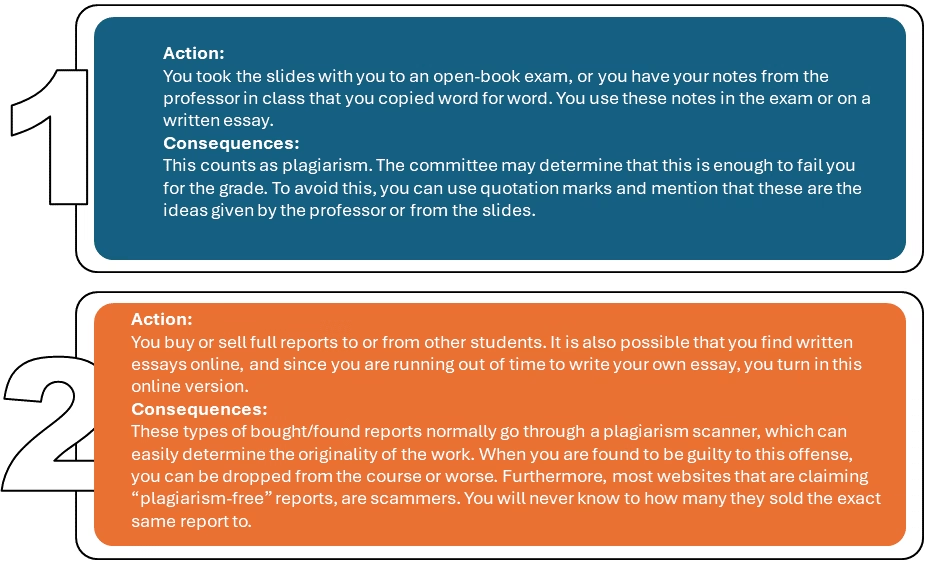
Figure listing various forms of academic dishonesty—such as plagiarism, cheating, and fabrication—alongside potential consequences including failing grades, disciplinary action, or expulsion. Designed as an educational aid for promoting academic integrity.

1. Investigation & What happens afterwards?

Upon discovery of plagiarism, the incident will be reported to the dean for review. Typically, a meeting between the course supervisor, dean, and student will be held to determine the appropriate action. Minor incidents may be handled directly, while major incidents are typically overseen by a university committee. The student may also be required to seek external counseling. Each university has its own academic integrity committee, so the specific penalties may vary. Regardless, plagiarism should not be taken lightly as the consequences can be severe.

Leave a comment

This site uses Akismet to reduce spam. Learn how your comment data is processed.