



Tourbillon watches are rarely affordable—many cost well into the hundreds of thousands of euros, with even the most “affordable” Swiss-made models starting around €8,000. I’ve been fascinated by these types of watches for a while now, though I definitely don’t have that kind of cash lying around. In this article, I’ll explore what a tourbillon is, its fascinating history, and some options that are more accessible for those of us without deep pockets.
The Origins of the Tourbillon
Like many breakthroughs in horology, the concept of the tourbillon originated in Britain. It was conceived by John Arnold, a pioneer in precision watchmaking. However, it was near the end of his life when the idea fully materialized, so he entrusted its realization to his close friend, the legendary Abraham-Louis Breguet. Breguet brought the concept to life and patented the tourbillon in 1801—just two years before Arnold’s death.
Originally designed for pocket watches, the tourbillon addressed a major issue: these timepieces spent most of their life in a single vertical position. This caused gravity-induced positional errors in the movement’s accuracy—sometimes by several minutes a day. The idea behind the tourbillon was to mount the escapement and balance wheel in a rotating cage, averaging out these errors. Breguet named it “whirlwind,” which in French is tourbillon. The meaning will become clearer by the end of this article
Is the Tourbillon Still Relevant Today?
While a brilliant solution for pocket watches, the tourbillon offers little practical benefit for modern wristwatches. Because wristwatches are constantly changing position throughout the day, the original issue it aimed to solve no longer really applies. Still, that hasn’t stopped the tourbillon from becoming one of the most admired complications in horology.
Why? Because it’s beautiful. A flying tourbillon spinning on your wrist is nothing short of mesmerizing. It turns your watch into a piece of kinetic art. And in my view, watches today aren’t just about telling time—they’re a form of self-expression. Most men don’t wear much jewelry, so a watch often becomes the centerpiece of personal style. Owning a tourbillon, even an affordable one, is a statement of appreciation for craftsmanship, history, and engineering excellence.
How Does a Tourbillon Work?
Before understanding the intricate details of the tourbillon, we need to understand what the main spring, balance wheel and the escapement (escape wheel + pallet fork) are.

In mechanical watches, the energy that keeps your watch running for hours after winding is stored in the mainspring. Like any coiled spring, it wants to release all of its energy at once. However, the escapement controls this release by locking and unlocking the gear train, regulating the flow of energy from the mainspring. But more on that later.
As the mainspring unwinds, it turns a series of gears in one direction, eventually driving the escape wheel. The escape wheel tries to rotate, but its teeth are held in check by the pallet fork. When the balance wheel swings, it moves the pallet fork, briefly unlocking the escape wheel. This allows one of its teeth to push on the pallet fork, which then delivers an impulse to the balance wheel, keeping it oscillating.
The balance wheel resists this motion due to the hairspring connected to it, which acts as a restoring force. As the balance wheel swings back and forth, it causes the pallet fork to alternately lock and unlock the escape wheel. This process controls the rate at which energy is released from the mainspring.
The balance wheel and hairspring system has a natural frequency—often 4 Hz or 5 Hz—which means the escapement ticks 8 to 10 times per second. This gives the watch its smooth, sweeping second hand motion.
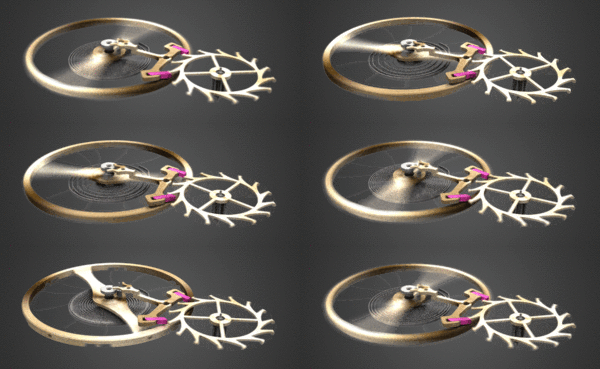
What the Tourbillon Adds to a Watch
Imagine the watch in an upright position, where the axis of the rotating balance wheel is horizontal. In this position, the balance wheel moves partly against gravity in one direction and with gravity in the other. This creates an asymmetry in the balance wheel’s motion, which can introduce small timing errors. The tourbillon addresses this issue by rotating the entire assembly of the balance wheel and escapement.
The construction is quite complex: the balance wheel and escapement are mounted inside a rotating cage that typically completes one full rotation every minute. This slow rotation averages out positional errors caused by gravity, improving timekeeping accuracy—especially in older pocket watches, which tended to remain in one position for long periods.

Because of its intricate construction and the precision required to build it, the tourbillon has become a symbol of horological mastery. Crafting a tourbillon demands exceptional skill, and watches that feature one are often highly prized by collectors. This is also why tourbillons are usually prominently displayed on the front of the watch, allowing the wearer to admire the mechanism in motion. A great example is the Blancpain tourbillon, shown in the picture, which carries a price tag of several tens of thousands of euros.
My Thoughts on the Tourbillon
Ever since I bought my first watch eight years ago, I’ve been fascinated by these mechanical wonders. Personally, I prefer a purely mechanical watch over an electronic one—perhaps not what you’d expect from someone working in the electronics industry.
My first watch had a transparent case back, allowing a view of the inner mechanics. It’s just unfortunate that you can’t see that side while actually wearing the watch. I’ve seen tourbillons before (in pictures), and knowing their price, I understand this isn’t something I can buy on a whim. One of the more affordable options is the TAG Heuer Carrera Heuer-02 Tourbillon, which comes in at around €10,000. However, it’s not quite my style—I prefer a more classic look in my watches, like the Blancpain Tourbillon shown in the figure above. I let the idea go, until I saw the following watch.
I want to start by saying that this is not a sponsored article. From this point on, I’ll talk a bit about a watch I came across online that really caught my eye.
The Sugess Tourbillon with Roman numerals, priced at around €650, seems almost too good to be true. It’s hard to believe that such a complex piece can be manufactured at such a low cost. This type of watch is more or less what I like. Besides the tourbillon, there is nothing fancy, which only highlights the masterpiece more inside the watch.
Sugess is a brand founded in 2011 and based in Shenzhen, China. Its movements are primarily sourced from Seagull, a well-known Chinese movement manufacturer. While these watches don’t match the quality of Swiss-made timepieces, the price difference is significant—sometimes as much as a hundredfold.
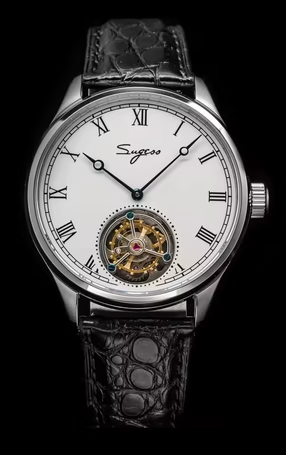
My main concern is the long-term servicing of the watch. Most regular watchmakers aren’t equipped to handle tourbillons, especially ones from Chinese brands. In addition, there are some user reports about dust particles inside the movement and insufficient lubrication on the jewels, which could affect reliability over time.
I’m still saving for my next watch, and I may or may not end up buying this one. But I thought it would be interesting to share a bit about one of my other hobbies here—particularly this mechanical wonder. If you have any suggestions for similar watches, perhaps from more reputable brands, feel free to leave a comment. I’ll definitely take it into consideration.

Florius
Hi, welcome to my website. I am writing about my previous studies, work & research related topics and other interests. I hope you enjoy reading it and that you learned something new.
More Posts







Comments
Wow , you have a really timeless taste and really good understanding on the watch . Good luck on saving
Thanks!