


The abstract is part of the series on how to write your dissertation. An abstract is a short summary that outlines all important parts of your research. It is situated in between the acknowledgements and table of content. It is slightly different from a summary that only states what the research is about; an abstract also explores the findings.
1. Why write an abstract?
Abstracts play a crucial role in the selection and indexing of academic articles.
Selection: A well-written abstract not only assists readers in determining whether the content is relevant to their interests but also helps them decide if they should read the entire paper.
Indexing: It’s essential for abstracts to include the key terms that a researcher might use to perform their search easily. Therefore, a meticulously written abstract strengthens the visibility of the paper in the academic community and the chances of being cited by potential users.
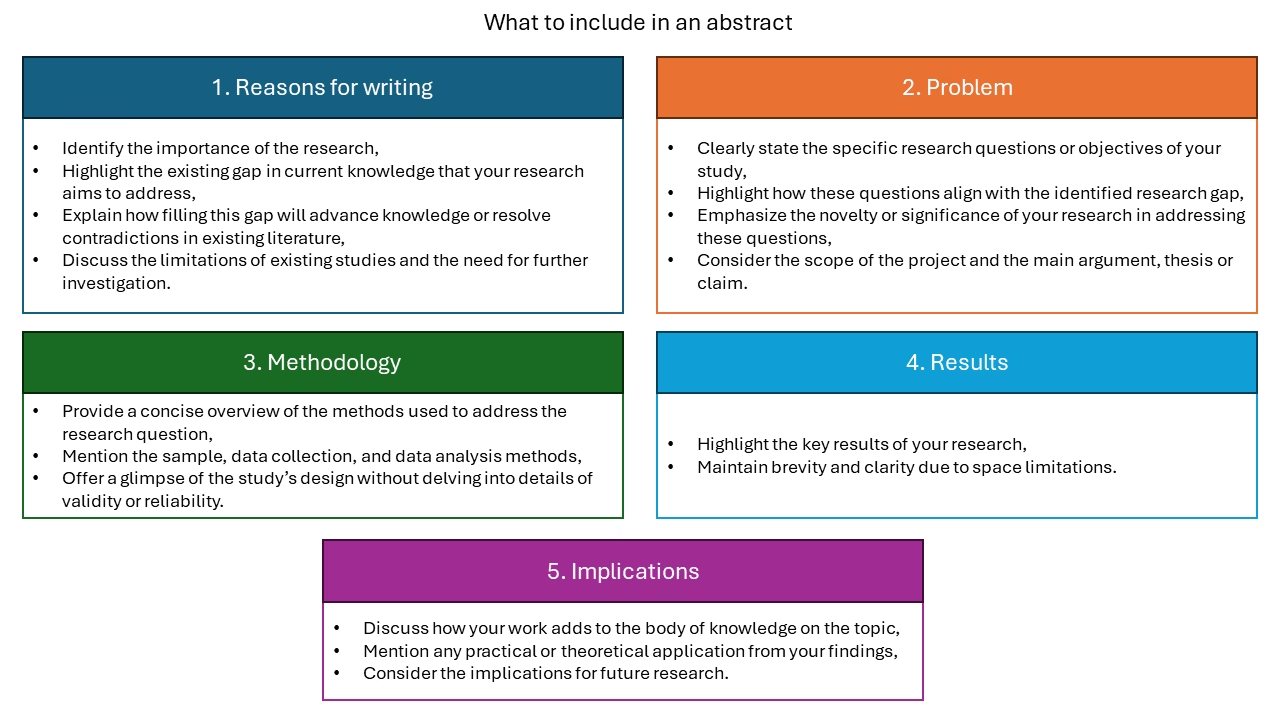
2. What to include in an abstract
The structure of an abstract is similar to the rest of your dissertation, but it does depend on the discipline in which you are working. However, all abstracts cover the following five sections.
3. Types of abstracts
Abstracts can be informative, descriptive or critical. It is essential you pick the right type for your dissertation subject.
The majority of written abstracts are Informative. These type of abstracts offer the reader a concise overview of your research, including the principle results and conclusion.
Descriptive abstracts describe the work being abstracted. They are more like an outline of the work and are usually very short – 100 words or less.
A critical abstract offers readers a comprehensive overview of the research while incorporating an evaluative component. It not only summarizes the research data but also analyzes it, discusses the implications, and asserts the accomplishments of the study. This type of abstract goes beyond mere description by critically examining the research data and recounting its significance and broader implications.
4. Keywords in abstracts
When crafting thesis abstracts, the inclusion of keywords is paramount. Keywords are phrases or words that assist readers in identifying the main topics addressed in your paper, making it more convenient for them to locate specific information. Typically, keywords should be positioned at the conclusion of the dissertation abstract and formatted in italics. Furthermore, incorporate keywords that encapsulate the primary research interests and topics explored in your paper. Lastly, employ these keywords throughout your thesis to ensure that your abstracts accurately reflect the content of the entire paper.
In addition to the aforementioned points, it is important to consider the following aspects when selecting and utilizing keywords in your thesis abstract:
- Relevance and Specificity: Choose keywords that accurately represent the core themes, concepts, and objectives of your research. Opt for precise and specific terms that succinctly capture the essence of your work. This aids in ensuring that your abstracts align closely with the content of your paper and attract readers interested in those particular areas.
- Variation and Synonyms: Include a range of related keywords to accommodate different reader preferences and search strategies. Consider using synonyms or alternative expressions that convey the same or similar meanings. This expands the visibility of your abstracts and improves the likelihood of your work being discovered by individuals searching for different terminology.
- Field-specific Terminology: Incorporate keywords that are commonly used within your specific field or discipline. By including domain-specific terminology, you increase the chances of your paper being recognized and accessed by researchers and practitioners in your area of study.
- Research Methodology or Approach: If applicable, include keywords that denote the specific research methodologies or approaches utilized in your study. This can encompass quantitative or qualitative methods, experimental designs, data analysis techniques, or theoretical frameworks employed in your research.
- Emerging or Important Concepts: Identify and include keywords that highlight emerging or significant concepts within your research area. This allows your work to be associated with cutting-edge developments and relevant discussions in the field, increasing its visibility and attracting interest from scholars and researchers engaged in those areas.
By incorporating these considerations into your selection and use of keywords, your thesis abstracts become more effective in conveying the main topics of your paper, facilitating discoverability, and attracting readers with specific interests in your research.
5. Examples of abstracts
2
Abstract
(Example 1)
This dissertation presents a theoretical study of the properties of quantum systems in the presence of strong external fields. We developed a new approach to analyze the effects of intense laser fields on the dynamics and spectra of small atomic and molecular systems. Our calculations show that the strong-field ionization and high-order harmonic generation processes can be accurately described by the solutions of the time-dependent Schrödinger equation in the framework of a semi-classical model. We also found that the non-perturbative effects of the laser-dressed states lead to a significant modification of the electron-ion recombination rates and the high-order harmonic spectra. The results of this study have important implications for the development of new techniques for the control and manipulation of quantum systems in strong-field physics and attosecond science.
Keywords: Quantum Systems, Strong External Fields, Intense Laser Fields, Time-dependent Schrödinger Equation, Laser-dressed States
(Example 2)
This dissertation examines the impact of parental involvement on academic achievement among low-income minority students. Using a mixed-methods approach, the study surveyed 300 parents and conducted in-depth interviews with 20 parents and 20 teachers in three urban schools. The findings indicate that parental involvement, specifically in the areas of communication with teachers, volunteering at school, and monitoring of homework, is positively associated with academic achievement. Additionally, teachers reported that parental involvement improved their ability to provide individualized support for students. The study also found that cultural and linguistic barriers, as well as lack of access to resources, can impede parental involvement. The results of this research highlight the importance of parental involvement in the academic success of low-income minority students and provide insights for educators and policymakers to improve family-school partnerships.
Keywords: Parental Involvement, Low-income Minority Students, Mixed-Methods Approach, Family-School partnerships
6. Extra tips
Writing a dissertation or PhD thesis abstract is a challenging endeavor that requires careful attention to ensure its alignment with the content of your paper. To assist you, I offer some extra tips on writing an abstract for your dissertation or thesis. Coupled with the example of a dissertation abstract provided above, you can proceed with confidence, knowing that you are following the correct approach.
- Keep the abstract concise, with no more then 300 words.
- Be specific and concrete.
- You can add keywords in white font color, that won’t be read by the reader, but the compiler will pick them up.
- Use words such as “Investigate”, “Analyze” or “Evaluate” to describe the research’s actions.
- Write in the present simple tense, unless you are talking about events (e.g. data collecting) that took place in the past; than use past simple tense.
- Focus on the:
- Why: The reason behind the research being done.
- How: The basic approach and methodology, usually in one sentence.
- What: The main findings (results) in very few sentences.
- So what: The conclusion (briefly) and the broad implications of it.
- It is slightly different from a summary that only states what the research is about; an abstract also explores the findings.