RSS Daily tech news
  • These tiny holes could change how the world cleans water
    A new nature-inspired membrane uses perfectly uniform one-nanometer pores to filter molecules with remarkable precision. The technology could transform industries such as pharmaceuticals and textiles by reducing energy consumption, improving water reuse, and delivering separation performance far beyond current filters.
  • Scientists discover a hidden quantum world inside cobalt
    Scientists have uncovered unexpected quantum complexity inside cobalt, a metal long thought to be fully understood. Advanced measurements revealed a dense network of topological electronic states that remain robust at room temperature. These states enable extremely fast electron behavior and can be switched or controlled using magnetism. The discovery could open new paths toward next-generation […]
  • A 100-year-old piano mystery has finally been solved
    For more than a century, pianists and music teachers have argued over whether a performer’s touch can actually change the tone color of a piano note — and now scientists say the answer is yes. Using a cutting-edge sensor system that tracked piano key movements at 1,000 frames per second, researchers discovered that elite pianists […]
  • Ordinary WiFi can now identify people with near perfect accuracy
    Scientists in Germany have demonstrated a startling new form of surveillance: identifying people using nothing more than ordinary WiFi signals. By analyzing how radio waves bounce around a room, researchers can effectively “see” and recognize individuals — even if they are not carrying a device and even if their phone is turned off.
  • New quantum sensor could count individual photons and hunt dark matter
    Researchers have built an ultra-sensitive sensor capable of detecting unimaginably small amounts of energy — below one zeptojoule. The breakthrough relies on fragile superconducting materials that react to even the slightest temperature change. This level of precision could improve quantum computers, enable photon counting, and even help scientists detect elusive dark matter particles from space.
  • New quantum algorithm solves “impossible” materials problem in seconds
    A new quantum-inspired algorithm has cracked a problem so massive that conventional supercomputers struggle to even approach it. Researchers used the method to simulate extraordinarily complex quantum materials known as quasicrystals, opening the door to powerful new quantum devices and ultra-efficient electronics. The work could help scientists design advanced topological qubits and materials for future […]
Figures and tables list

Dissertation Figure and Table List | Tips and Examples

by Florius

The list of figures or tables is part of the series on how to write your dissertation and it should be placed immediately following the table of contents in your dissertation. This list should include all figures or tables used in the document, along with their captions and corresponding page numbers. While these lists are not required, they can make the overall document more organized and easy to navigate. Additionally, be sure to provide descriptive captions for each figure or table, such as “High Field Quasi-Optical Experimental Setup” instead of simply “Experimental Setup.”

1. How to create a list of figures in Word

To create a list of figures, tables or even equations in MS Word, can be difficult if you do not know where to look. Below I explain with figures and text how to make your own list. For additional information, please consult the website of Microsoft Office.

  • Place the cursor on the top of the page where you want the list of figures/tables to be.
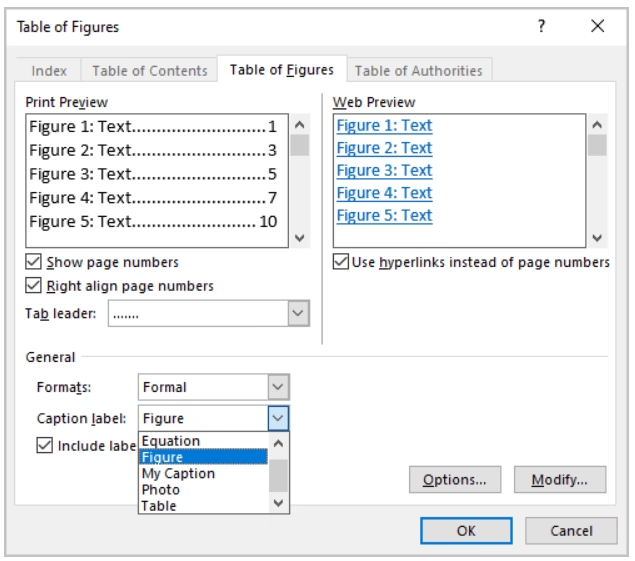
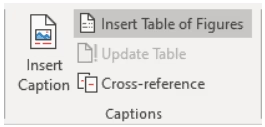
  • Go to References > Insert Table of Figures (Even if you want to make a list of tables or equations).
How to create a list of figures.
  • In the dialog box, select the label for which you want to make the list from the “Caption Label Pulldown” (this can be Equation, Figures, Tables).
  • You can change the formatting in the same dialog box to Formal.
How to create a list of figures.

2. Example

LIST OF FIGURES

Figure 1. Flowchart of the research methodology……………………………………………………………………………………………1

Figure 2. Bar graph illustrating the relationship between X and Y variables……………………………….2

Figure 3. Scatterplot showing the correlation between A and B…………………………………………………………..3

Figure 4. Schematic diagram of the experimental setup…………………………………………………………………………4

Figure 5. Pie chart representing the distribution of survey responses……………………………………………5

Figure 6. Line graph depicting the trend of the data over time…………………………………………………………….6
Leave a comment

This site uses Akismet to reduce spam. Learn how your comment data is processed.

Categories
Instagram