


Plagiarism comes in many forms, but at its core, it involves presenting someone else’s ideas as your own. It’s important to be familiar with plagiarism when writing papers, articles, and other documents, as it can lead to both ethical and legal repercussions. Even if plagiarism is unintentional, universities and other institutions may still take action. To learn more about the different types of plagiarism and how to avoid them, read on and gain a deeper understanding of the topic. This post was inspired by this external post. Please see the links below for more reading.
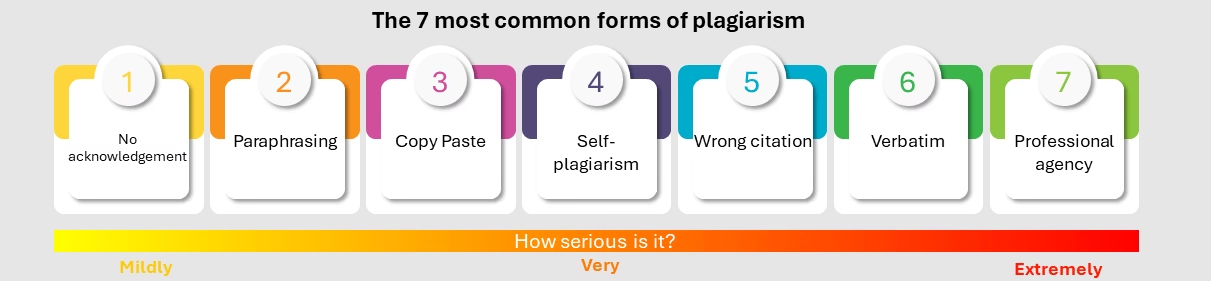
1. No acknowledgment for external help
Research is hardly ever a solo effort. Most of the times, you will work with others, or you have someone supervise you throughout the first weeks of your experiments. Some examples: advice from a student, the laboratory technicians, or your supervisor. Therefore, it is good practice to acknowledge the assistance that you received during your work.
Most likely they will be co-authors on your paper, or they will be mentioned in the acknowledgement section at the end of your paper. In certain fields (including my own), the community is not that large and people know each other. by acknowledging them, or having them as co-authors, you extend your network and perhaps in the future you can assist them in the same way.
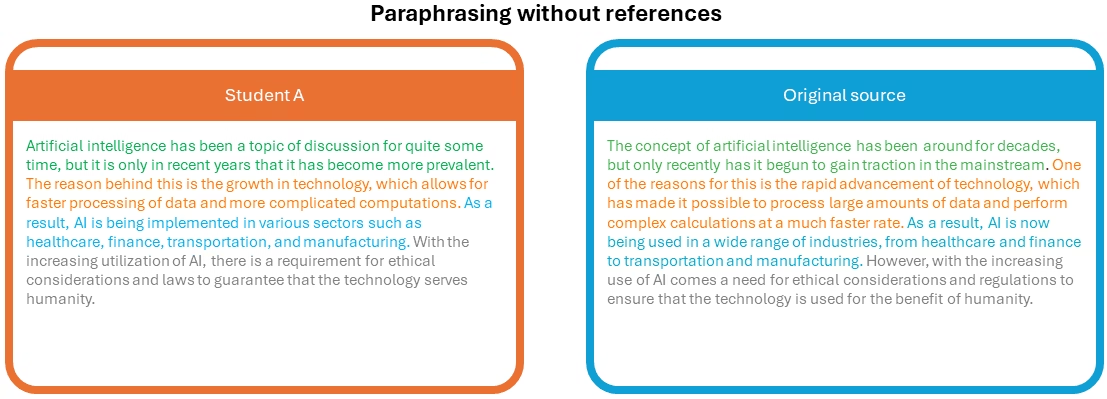
2. Paraphrasing
Rewriting someone else’s text in your own words is still considered plagiarism if proper citation is not provided. It may be tempting to do so to evade plagiarism detection tools (such as Turnitin), but most experienced readers will recognize the borrowed concepts. A better approach is to summarize the original text and provide a reference, rather than misleading the reader.
3. Copy pasting internet sources without quotations
It is important to note that any source found online, including websites, online journals, and podcasts, must be cited in your work. Keep in mind that most of these sources are not peer-reviewed, unlike academic journals. This is also the reason why it is considered poor practice to use websites such as Wikipedia as a source. Instead, you can use or look up the references that Wikipedia cites.
4. Self-plagiarism
It is not acceptable to publish work that has already been published by yourself elsewhere. This is especially important for students, as reusing work from one course for another may be considered unethical. There are several reasons to avoid this practice:
- Research in the scientific community is built on the principle of advancing knowledge and results. Recycling previously used material or duplicating publications can damage your reputation and lower your standing in the public’s view.
- Once you submit your work for publication, it becomes the property of the journal. It is therefore against the rules to submit the same work to multiple journals (which is called concurrent submission), as this is considered unethical and may be considered copyright infringement.
- Most journals use software to scan papers for plagiarism, and if your work is flagged, it may delay publication or result in rejection.
5. Wrong citation
When publishing a paper or any other report, strict formatting guidelines must be adhered to. This applies not only to the text itself but also to the style of references. For example, you can find the formatting guide for Nature papers. It is therefore of the utmost importance to use the correct referencing style (IEEE, MLA, or APA) as failure to do so may result in the paper not getting published. For your manuscript or other types of reports, always check with your university’s guidelines or ask your professor for the appropriate convention.
It is important to always use an in-text citation in combination with a list that displays all the relevant information to locate the correct source.
As a side note, when writing your paper or thesis, make sure to not include any references that you have not consulted. This is because people will check those references and if they find that they are not relevant to your content, it will discredit the entire paper. Additionally, for certain journals, there is a maximum number of citations and references that you can use.
6. Verbatim without quotations
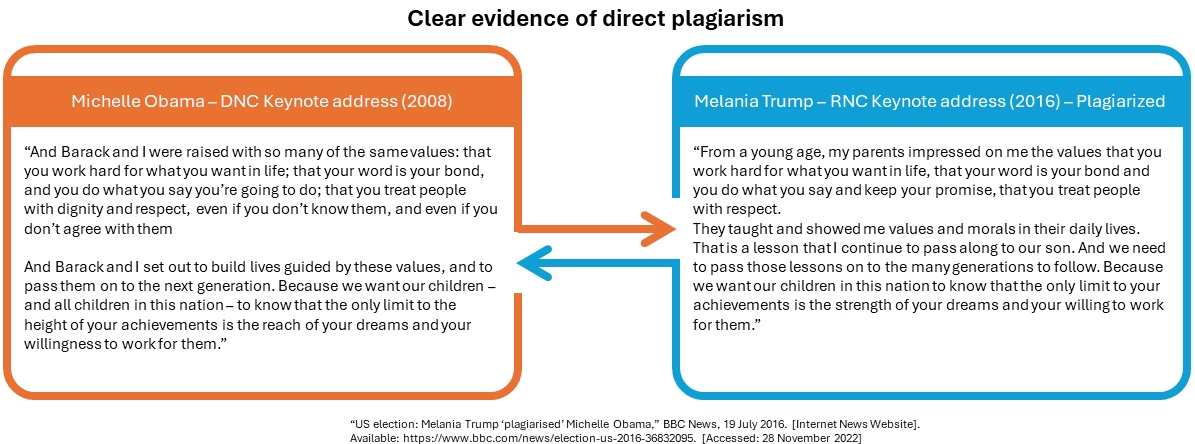
When using verbatim text, it is important to clearly indicate that it is not original by using indentation or quotation marks. Even minor changes to the text will be considered verbatim plagiarism and can be flagged by plagiarism checkers like Turnitin.
In academic writing, it is crucial to properly cite and reference any borrowed text, whether it is a large block (50 – 100 words) or a shorter passage. The format for in-text citations and references varies depending on the chosen citation style, such as MLA, APA, or IEEE. It’s important to be consistent with the citation style used throughout the paper, and to follow the guidelines provided by the university or journal.
7. Using professional agencies
It is a given that hiring others to write your text is unacceptable. This applies to both friends and professional writing agencies. All written work completed during your academic career should be your own, which is what universities expect from students.
However, it is acceptable and even recommended to have others proofread your manuscript or paper before submitting it. They can provide feedback and make necessary corrections.
Frequently asked questions
Simply put, plagiarism is when you’re passing off someone else’s idea as your own. Any time you copy or paraphrase someone’s idea, you should give credit to the owner
There are several ways to avoid plagiarism, including:
Understand what plagiarism is and what it entails: Plagiarism is the act of using someone else’s work or ideas without giving them proper credit. It is important to understand what constitutes plagiarism and to be aware of the different forms it can take.
Properly cite and reference all sources: When using someone else’s work or ideas, it is important to properly cite and reference the source, both in the text and in a bibliography or reference list. This includes both direct quotes and paraphrasing.
Use plagiarism detection software: Tools like Turnitin or Grammarly can help detect plagiarism and help you identify and correct any instances of unintentional plagiarism.
Practice good research habits: Practice good research habits, such as keeping detailed notes and records of your sources, and organizing your research materials. This can help you avoid plagiarism by making it easier to properly cite and reference your sources.
Understand the citation style: Different fields and journals use different citation styles (such as MLA, APA, Chicago, etc.). Familiarize yourself with the citation style required for your assignment or manuscript and make sure to follow it consistently.
Understand the limits of common knowledge: Some information is considered common knowledge and does not need to be cited. However, it can be difficult to determine what constitutes common knowledge, so it is best to err on the side of caution and cite any information that may be in question.
By following these guidelines, you can avoid plagiarism and maintain academic integrity in your work.
Copyright laws are a set of legal rules that govern the use and distribution of original works of authorship, such as literary works, music, films, and software. Copyright laws are intended to protect the rights of creators by giving them exclusive control over the use of their works.
Copyright laws give creators the right to:
- reproduce their work
- create derivative works
- distribute copies of the work
- publicly perform the work
- publicly display the work
Plagiarism, on the other hand, is the act of using someone else’s work or ideas without giving them proper credit. Plagiarism is considered an ethical violation in academic and professional settings and can lead to disciplinary action.
While both copyright laws and plagiarism are related to the use of others’ work, they are different concepts. Copyright laws protect the rights of creators by giving them control over the use of their work, while plagiarism is the act of using someone else’s work without giving them proper credit. Copyright laws are a legal issue, while plagiarism is an ethical issue.
It is important to note that copyright laws do not protect ideas or facts, but only the expression of those ideas. Additionally, not all creative works are protected by copyright, such as works that are in the public domain or are considered common property.
Not all, examples are:
- Work in the public domain, as long as you cite them properly.
- Facts that are not the results of research (such as that the sky is blue).
Yes, you still need to cite the source even if you change a few words. This is because even small changes to text still constitutes as paraphrasing, which is a form of plagiarism if not properly cited. Paraphrasing is the act of restating someone else’s ideas or text in your own words, and it is just as important to give credit to the original source as it is for direct quotations.
Most universities have zero tolerance for plagiarism. This can result in failure of the course, or even expulsion from the university.