


This guide on APA referencing is based on the 7th Edition of the APA manual. We go in depth on the APA in-text citation, the references for all different sources (e.g. books, journals, media, etc) and the last part is about the format of the reference list that contains all the sources that you have used throughout your work.
Here we give you a basic overview of the latest edition of the APA style guidelines. I’d recommend to read the other posts if you require more details and more examples on each topic:
1. In-text citation | The basics
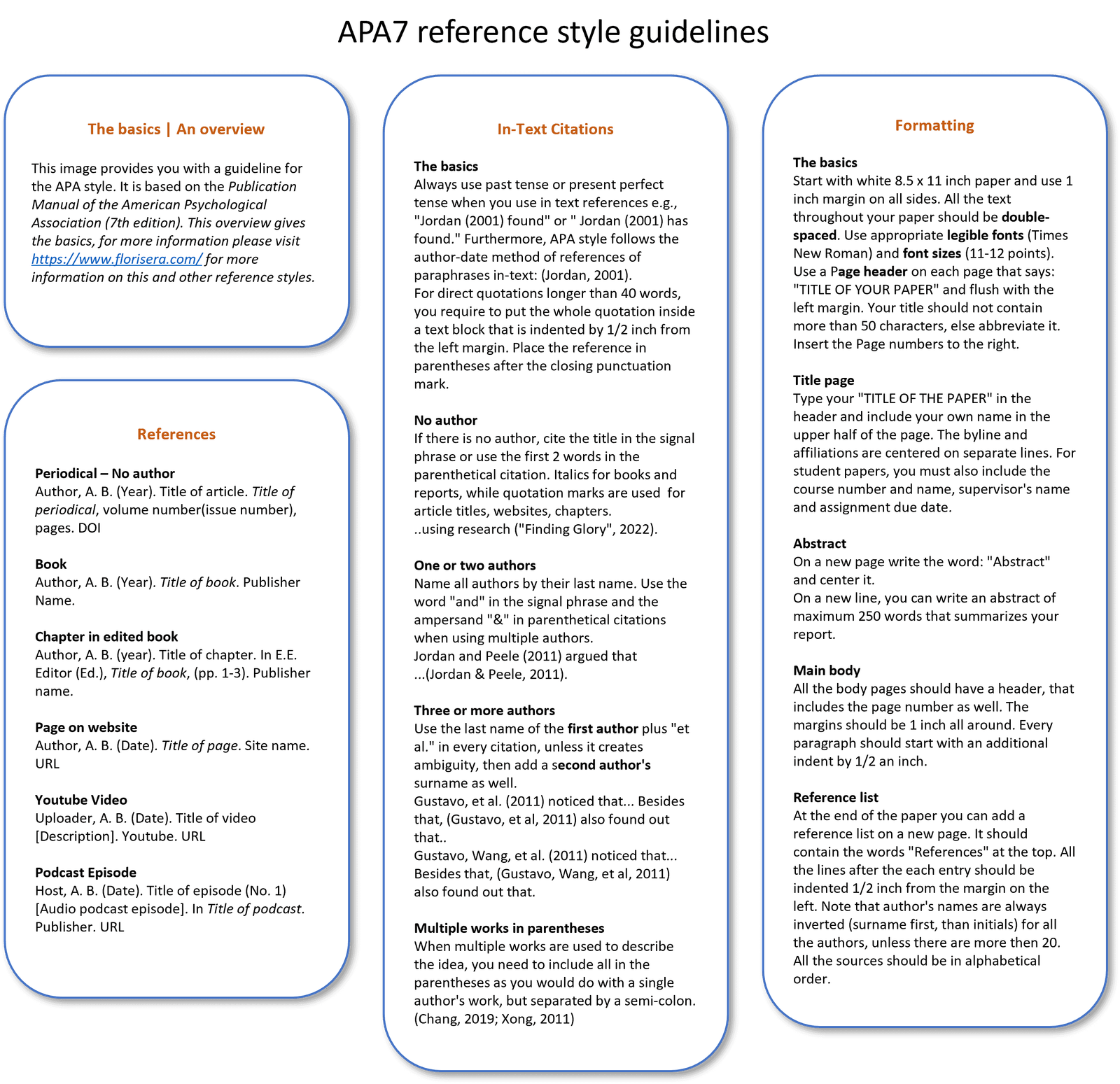
We go over the basics for in-text citations in this paragraph. For a more in-depth knowledge with more examples, please check our page on APA in-text citations
Always use past tense or present perfect tense when you use in text references e.g., “Jordan (2001) found” or ” Jordan (2001) has found.” Furthermore, APA style follows the author-date method of references of paraphrases in-text: (Jordan, 2001).
For direct quotations longer than 40 words, you require to put the whole quotation inside a text block that is indented by 1/2 inch from the left margin. Place the reference in parentheses after the closing punctuation mark.
No Author
If there is no author, cite the title in the signal phrase or use the first 2 words in the parenthetical citation. Italics for books and reports, while quotation marks are used for article titles, websites, chapters.
..using research (“Finding Glory”, 2022).
One or two authors
Name all authors by their last name. Use the word “and” in the signal phrase and the ampersand “&” in parenthetical citations when using multiple authors.
Jordan and Peele (2011) argued that …(Jordan & Peele, 2011).
Three or more authors
Use the last name of the first author plus “et al.” in every citation, unless it creates ambiguity, than add a second author’s surname as well.
Gustavo, et al. (2011) noticed that… Besides that, (Gustavo, et al, 2011) also found out that..
Gustavo, Wang, et al. (2011) noticed that… Besides that, (Gustavo, Wang, et al, 2011) also found out that.
Multiple works in parentheses
When multiple works are used to describe the idea, you need to include all in the parentheses as you would do with a single author’s work, but separated by a semi-colon.
(Chang, 2019; Xong, 2011)
2. References | The basics
Down here you find the most used references. For examples and more references, please follow see our page on APA7 references.
Author, A. B. (Year). Title of article. Title of periodical, volume number(issue number), pages. DOI
Author, A. B. (Year). Title of book. Publisher Name.
Author, A. B. (year). Title of chapter. In E.E. Editor (Ed.), Title of book, (pp. 1-3). Publisher name.
Uploader, A. B. (Date). Title of video [Description]. Youtube. URL
Host, A. B. (Date). Title of episode (No. 1) [Audio podcast episode]. In Title of podcast. Publisher. URL
Author, A. B. (Date). Title of page. Site name. URL
3. Formatting | The basics
I go over the basics to write your manuscript or papers with the APA7 formatting. A more in-depth guide with examples is given here. Start with white 8.5 x 11 inch paper, and use 1 inch margin on all sides. All the text throughout your paper should be double-spaced. Use appropriate legible fonts (Times New Roman) and font sizes (11-12 points). Use a Page header on each page that says: “TITLE OF YOUR PAPER” and flush with the left margin. Your title should not contain more than 50 characters, else abbreviate it. Insert the Page numbers to the right.
Title page
Type your “TITLE OF THE PAPER” in the header and include your own name in the upper half of the page. The byline and affiliations are centered on separate lines. For student papers, you must also include the course number and name, supervisor’s name and assignment due date.
Abstract
On a new page write the word: “Abstract” and center it.
On a new line, you can write an abstract of maximum 250 words that summarizes your report.
Main body
All the body pages should have a header, that includes the page number as well. The margins should be 1 inch all around. Every paragraph should start with an additional indent by 1/2 an inch.
Reference list
At the end of the paper you can add a reference list on a new page. It should contain the words “References” at the top. All the lines after the each entry should be indented 1/2 inch from the margin on the left. Note that author’s names are always inverted (surname first, than initials) for all the authors, unless there are more then 20. All the sources should be in alphabetical order.
If you are interested in referencing styles, see our other resources, including the IEEE reference style for engineers and the MLA reference style for arts and humanity studies. You can also check out our information page on References and citations to get a better understanding of the whole topic.