RSS Daily tech news
  • First ever atomic movie reveals hidden driver of radiation damage
    Researchers have visualized atoms in motion just before a radiation-driven decay process occurs, revealing a surprisingly dynamic scene. Instead of remaining fixed, the atoms roam and rearrange, directly influencing how and when the decay unfolds. This “atomic movie” shows that structure and motion play a central role in radiation damage mechanisms. The findings could improve […]
  • MIT scientists finally see hidden quantum “jiggling” inside superconductors
    MIT physicists have built a powerful new microscope that uses terahertz light to uncover hidden quantum motions inside superconductors. By compressing this normally unwieldy light into a tiny region, they were able to observe electrons moving together in a frictionless, wave-like state for the first time. This discovery opens a new window into how superconductors […]
  • A lab mistake at Cambridge reveals a powerful new way to modify drug molecules
    Cambridge scientists have discovered a light-powered chemical reaction that lets researchers modify complex drug molecules at the final stages of development. Unlike traditional methods that rely on toxic chemicals and harsh conditions, the new approach uses an LED lamp to create essential carbon–carbon bonds under mild conditions. This could make drug discovery faster and more […]
  • Scientists just found a way to 3D print one of the hardest metals on Earth
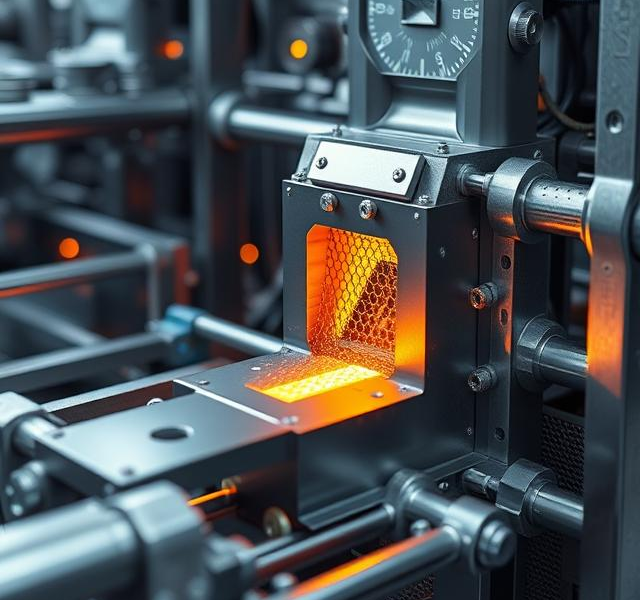
    Scientists have found a promising new way to manufacture one of industry’s toughest materials—tungsten carbide–cobalt—using advanced 3D printing. Normally, producing this ultra-hard material requires high-pressure processes that waste large amounts of expensive tungsten and cobalt. The new approach uses a hot-wire laser technique that softens the metals rather than fully melting them, allowing manufacturers to […]
  • Scientists turn scrap car aluminum into high-performance metal for new vehicles
    Scientists at Oak Ridge National Laboratory have created a new aluminum alloy called RidgeAlloy that can turn contaminated car-body scrap into strong structural vehicle parts. Normally, impurities introduced during recycling make this scrap unsuitable for high-performance applications. RidgeAlloy overcomes that challenge, enabling recycled aluminum to meet the strength and durability standards required for modern vehicles. […]
  • Electrons catapult across solar materials in just 18 femtoseconds
    Electrons in solar materials can be launched across molecules almost as fast as nature allows, thanks to tiny atomic vibrations acting like a “molecular catapult.” In experiments lasting just 18 femtoseconds, researchers at the University of Cambridge observed electrons blasting across a boundary in a single burst, far faster than long-standing theories predicted. Instead of […]

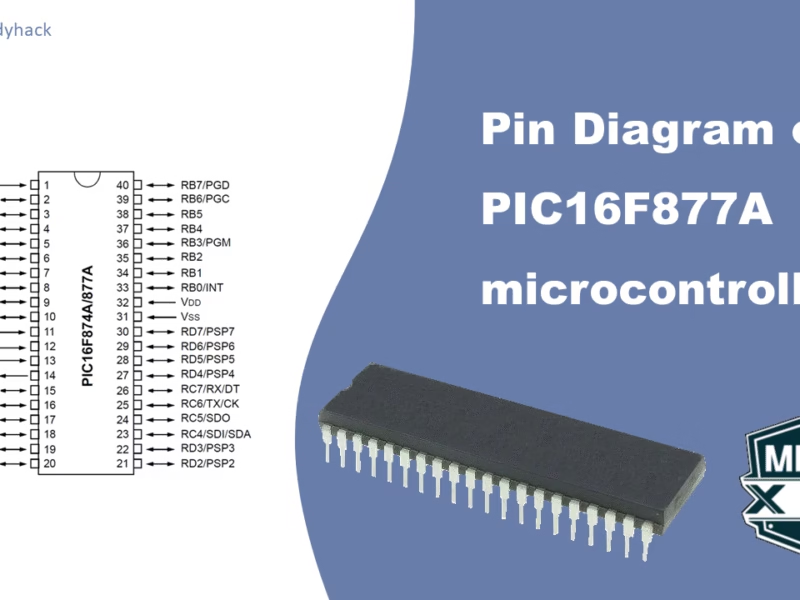
Pin diagram of the PIC16F877A microcontroller

by Florius
Illustration showing the 40-pin layout of the PIC16F877A microcontroller. Each pin is labeled with its corresponding port (e.g., RA0, RB7), alternate functions (such as ADC inputs, UART, SPI, I2C), and power supply pins (VDD, VSS). Used to guide hardware interfacing in MPLAB X IDE projects.

Pin diagram

The important pins

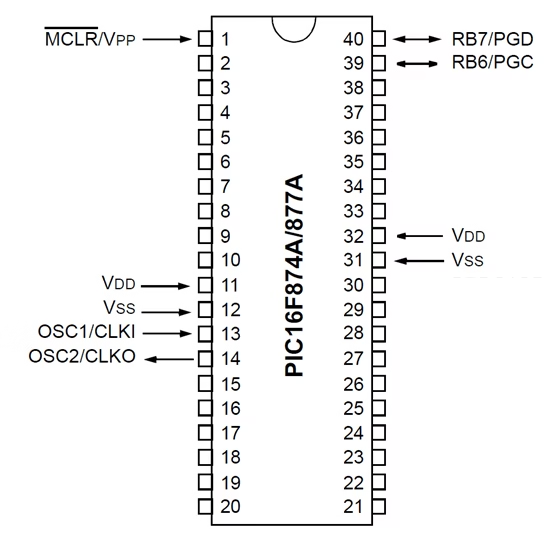
For accurate and dependable information, referring to the datasheets provided by Microchip Technology is advisable; these documents can be accessed here. Additionally, a brief overview of the pin diagram is recommended, detailing their functionalities and locations. Let’s begin by outlining the pins essential either for MCU operation or Pickit3 programmer-based programming:

  1. Pin 1 houses the MLCR/VPP, serving as a microchip reset mechanism.
  2. Pins 11 and 32, designated as VDD, necessitate a voltage range of 3.3V to 5V for proper functioning.
  3. Pins 12 and 31, denoted as VSS, are connecting to the ground
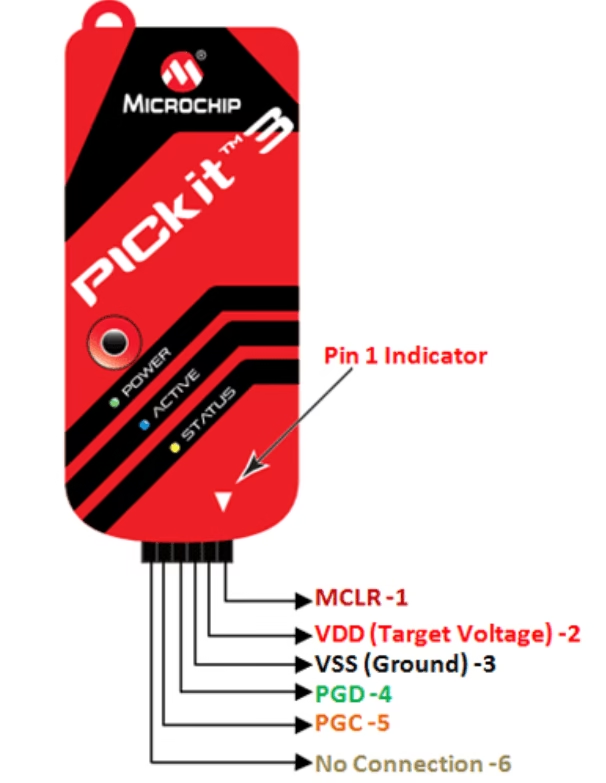
  4. To establish a connection with the Pickit3 programmer, pins 40 and 39 host PGD and PGC, respectively.
  5. Pins 13 and 14, namely OSC1 and OSC2, deliver a stable clock signal to the microcontroller. When utilizing the Pickit3 programmer, connecting these pins is unnecessary, thanks to the internal oscillator within the programmer facilitating MCU programming.

The exact method to program with your PICKIT3 programming tool, can be found here.

Pin diagram of the PIC16F877A; Programming pins
Pickit3 programming pins

Port structure in the PIC16F877A

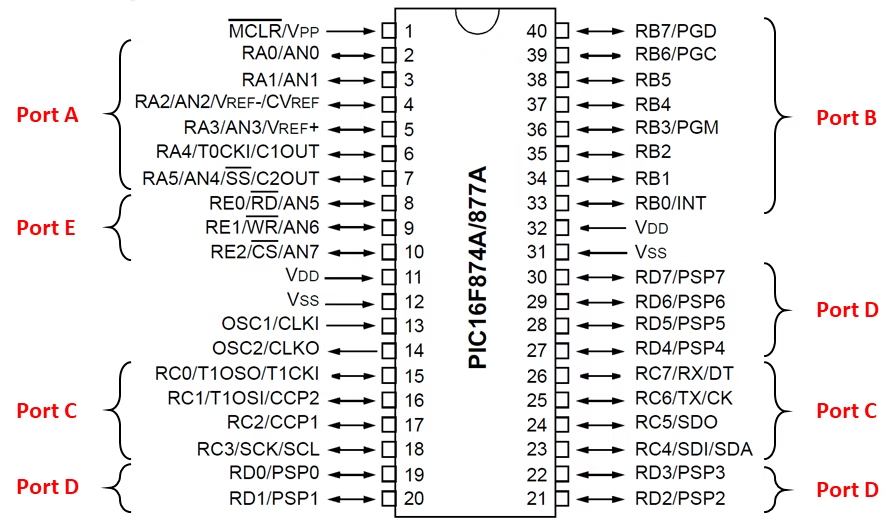
The PIC16F877A has 5 ports, namely A to E, where each pin can be configured as an input or output. However, it is important to note that not all ports consist of the same number of bits, due to some pins being taken by VSS or VDD, for example. In detail, port A consists of 6 bits, ports B, C, and D have 8 bits, while port E consists of only 3 bits.

Apart from being used for General Purpose Input Output (GPIO), most pins on this MCU have dedicated roles for specific functions. For instance, some pins on port C function as the TX and RX pins for the UART communication module, enabling the transmission and reception of serial data. Additionally, analog input channels for the ADC module on ports A and E can convert analog signals into digital values, opening up opportunities for further processing. When choosing IO pins, check the requirements of your project adequately to make the best possible decisions.
Labeled diagram of the PIC16F877A microcontroller showing all 40 pins with their port names (RA0–RA5, RB0–RB7, etc.), analog inputs, digital I/O, and special functions like USART, SPI, I2C, ADC, and oscillator pins. Useful for hardware design and firmware development in embedded applications.

Leave a comment

This site uses Akismet to reduce spam. Learn how your comment data is processed.