


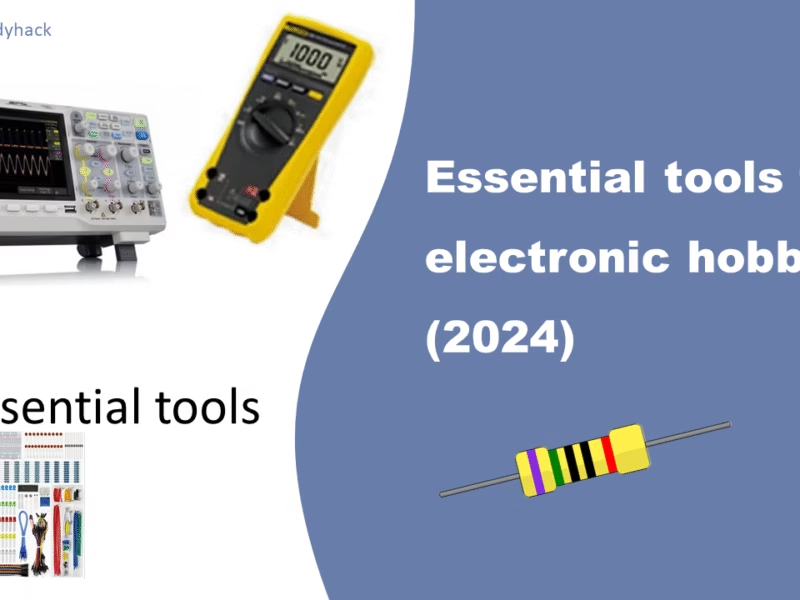
Lab equipment is essential for home-brewing. You need a soldering iron to build electronics, a power supply to provide energy to your circuit, and measurement equipment to test/verify its behaviour. This page lists the most important parts of what a lab should have.
As I focus on hobbyist, most of the gear is not high-end quality and can therefore be somewhat outdated or lower-end but still worth having. This is not affiliated marketing, and I am just showcasing what I think are great tools to have. Below you find my list of items and their prices:
- Multimeter (Brymen BM235 – €84.41)
- Soldering station (Atten AT-937 – €49.95)
- Hakko tip (3x 900M ~ €30.00)
- LAB PSU (Korad KA3005DS – €73.90)
- Solder (100g 0.7mm lead/tin – €15.79)
- Oscilloscope (Owon CDS1992I USB – €119.00)
- side cutters (€1.53)
- hot glue gun (€10,59)
- wires (250M wire 30AWG – €2.45)
- breadbord (Electronic kit – €11.99)
- resistor/capacitor kit (€10.39)
- diode kit (€2.93)
- buck converter (LM2596S – €2.95)
Depending on your region and send costs, this is around €400 in Europe or $450 in the USA. Below I give some more help on certain items that you might want to look out for!
Multimeter
For professional and commercial use, top brands known for their quality, durability, and precision include Fluke and Agilent. For hobbyists or semi-professionals, there’s a wide variety of brands to choose from. Some of the more popular options are Uni-T, Brymen, and Tenma, though many others are available. For low-voltage testing, even affordable “$20” meters can be sufficient, but it’s essential to check online reviews and user feedback for potential issues like poor-quality leads or non-fused high-current ranges. A good compromise can be to invest in an inexpensive meter and upgrade to higher-quality leads, such as those from ProbeMaster (e.g., 8000 series test leads).
It’s difficult to recommend a single cheap multimeter that can do everything, but some models that are worth considering include:
- Fluke 115 True RMS
- Brymen BM235
- Uni-T UT61E
Aneng AN8008

Lab-Grade Power Supply:
Recommendations are highly subjective and depend on your specific needs. Personally, I prefer a 2- or 3-port power supply that can provide at least 5V, along with additional voltages for actuators and motors. Key factors to consider include linear power supplies, which generate less noise, as well as the precision and maximum voltage/amperage output. Ultimately, you should conduct your own research to find the best fit for your requirements. However, the following brands and models can serve as a good starting point:
- Look out for used HP/Agilent E3610
- Korad KA3005DS / Korad KA3005PS
- Tenma 72-10480
- GOPHERT CPS-3205 0-32V 0-5A Portable Adjustable DC Power Supply
Oscilloscope
With new oscilloscope models being released regularly, it can be difficult to make specific recommendations. Oscilloscopes, particularly those with bandwidths at 200 MHz or above, can be quite expensive. However, instead of using a stand-alone oscilloscope, you can get an USB oscilloscope, which you connect to your laptop/pc. These oscilloscopes normally only go to 25 MHz, but are a lot cheaper; such as the “Owon VDS1022I USB Oscilloscope“.
Here are a few notable models:
- Rigol DS1054Z, 50 MHz, 4 channels
- Rigol DS1202Z-E, 200 MHz, 2 channels
- Siglent SDS1202X-E, 200 MHz, 2 channels
- GW Instek GDS-1202B, 200 MHz, 2 channels
If you can find a second-hand oscilloscope from the higher-end range (down below), it could be a great bargain.
- Rigol DH0800 series, up to 100 MHz, 2-4 channels
- Rigol DH0900 series, up to 250 MHz, 4 channels
- Siglent SDS1000X HD, up to 200 MHz. 2-4 channels
- Siglent SDS2000X HD, up to 350 MHz, 4 channels

This is just a sample of models from these manufacturers, and many others are available with varying specifications and features.
For those on a tight budget, used analog oscilloscopes can sometimes be found for under $50. However, they come with some drawbacks—they’re often old, uncalibrated, and may fail soon. Repairs can be difficult because many analog scopes use custom integrated circuits that are hard to replace. For example, the Tektronix 465 was a classic analog scope widely used in teaching and is still sought after today. The Tek 2225 is another frequently mentioned model.
Soldering Station
The two big brands of soldering stations are Hakko and Weller. Personally I prefer Hakko with direct heated tips, but both Weller and Hakko have direct and indirect iron tips. However, many cheaper alternatives exist, and you are able to use the high-end tips of Hakko in combination with a cheaper soldering station to still get some comfort.
- Hakko FX-888DX
- Atten 50W AT-937 (compatible with the 900M tips)
- Fiyua 936 (or any other 936 Hakko clone is compatible with 900M and 18T tips).
It is worth buying a set of real Hakko tips, such as the 900M. It is the most common tip used by the majority of indirect heated irons. For the time being, you can use them with your clone and when you upgrade to the real deal, you can just keep using them. When looking for Soldering tips, 115 is designed for SMD work, 210 for larger SMD, and 245 for general purpose and higher power.
Solder material
Most manufacturers now use unleaded solder for environmental reasons, but for low-volume hobby work, leaded solder is often easier to use due to its lower melting point and smoother flow. However, be sure it’s still allowed in your country. The concern with leaded solder isn’t its immediate toxicity (as both leaded and unleaded solder produce flux fumes), but rather the environmental impact when products containing lead are discarded. Avoid cheap, low-quality brands, especially from China, as they tend to have insufficient flux content.
For small surface mount devices, thin solder is recommended of 0.3mm. However, it’s useful to have thicker solder for general tasks. For hobby electronics, the most common sizes are 1mm to 0.7mm (20-22 SWG) or 0.032″ (22 Gauge).
Leaded Solder:
The most common leaded solder for electronics is a 60/40 tin/lead mix. There’s also a variant with a small percentage of copper, which helps prolong the life of your soldering tips.
Unleaded Solder:
Unleaded solder is more difficult to work with, and I wouldn’t recommend it for beginners. However, brands like Kester K100LD and AIM SN100C offer decent performance at a reasonable price.
Components
Below are the remaining items to finish your set of tools. Obviously it depends on what you want, but every electronic hobbyist should have at least the following
- Flush side cutters
- hot glue gun
- wires
- breadbord
- resistor/capacitor kit
- diode kit
- buck converter
- Magnifier
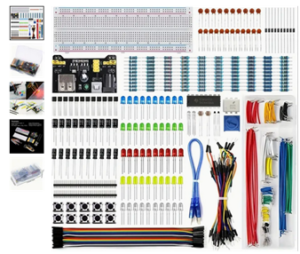
All these items can be bought from your local hobbystore or online for cheap. In addition, you might want to consider the following as well:
- Anti-static mat
- Helping-hand / Third hand / Soldering hand

Florius
Hi, welcome to my website. I am writing about my previous studies, work & research related topics and other interests. I hope you enjoy reading it and that you learned something new.
More Posts