
RSS Daily tech news
  • The hidden atomic gap that could break next-generation computer chips
    A major obstacle may be standing in the way of the next generation of ultra-tiny computer chips. Researchers discovered that many promising 2D materials lose their advantages because an invisible atomic-scale gap forms when they are combined with insulating layers. That tiny gap weakens electronic performance and could prevent further miniaturization. The team says new […]
  • Stanford’s new chip boosts light 100x with surprisingly low energy
    Researchers at Stanford have developed a compact optical amplifier that dramatically boosts light signals using very little power. By recycling energy inside a looping resonator, the device achieves strong amplification with minimal noise and wide bandwidth. Its efficiency and small size mean it could run on batteries and be integrated into consumer electronics. This breakthrough […]
  • Scientists capture electrons forming strange patchy patterns inside quantum materials
    Researchers have, for the first time, directly visualized how electronic patterns known as charge density waves evolve across a phase transition. Using cutting-edge microscopy, they found these patterns form unevenly, breaking into patches influenced by tiny structural distortions. Unexpectedly, small pockets of order persist even above the transition temperature. This reveals that electronic order fades […]
  • First ever atomic movie reveals hidden driver of radiation damage
    Researchers have visualized atoms in motion just before a radiation-driven decay process occurs, revealing a surprisingly dynamic scene. Instead of remaining fixed, the atoms roam and rearrange, directly influencing how and when the decay unfolds. This “atomic movie” shows that structure and motion play a central role in radiation damage mechanisms. The findings could improve […]
  • MIT scientists finally see hidden quantum “jiggling” inside superconductors
    MIT physicists have built a powerful new microscope that uses terahertz light to uncover hidden quantum motions inside superconductors. By compressing this normally unwieldy light into a tiny region, they were able to observe electrons moving together in a frictionless, wave-like state for the first time. This discovery opens a new window into how superconductors […]
  • A lab mistake at Cambridge reveals a powerful new way to modify drug molecules
    Cambridge scientists have discovered a light-powered chemical reaction that lets researchers modify complex drug molecules at the final stages of development. Unlike traditional methods that rely on toxic chemicals and harsh conditions, the new approach uses an LED lamp to create essential carbon–carbon bonds under mild conditions. This could make drug discovery faster and more […]

Category

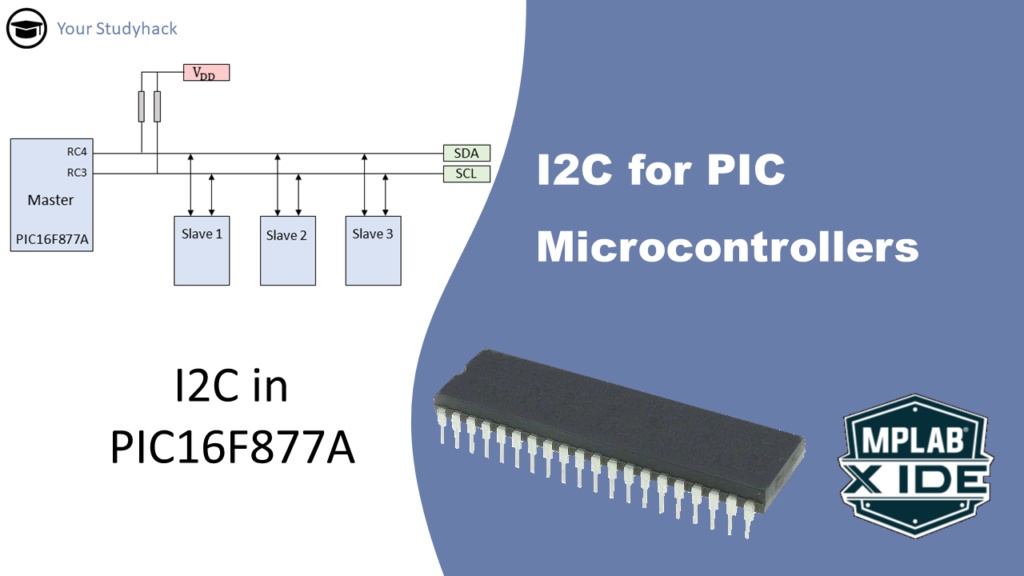
Featured image of I2C for PIC microcontrollers
I2C for PIC Microcontrollers
In this article, we will take a closer look at the I2C serial communication protocol. This is the second in a series of three articles...
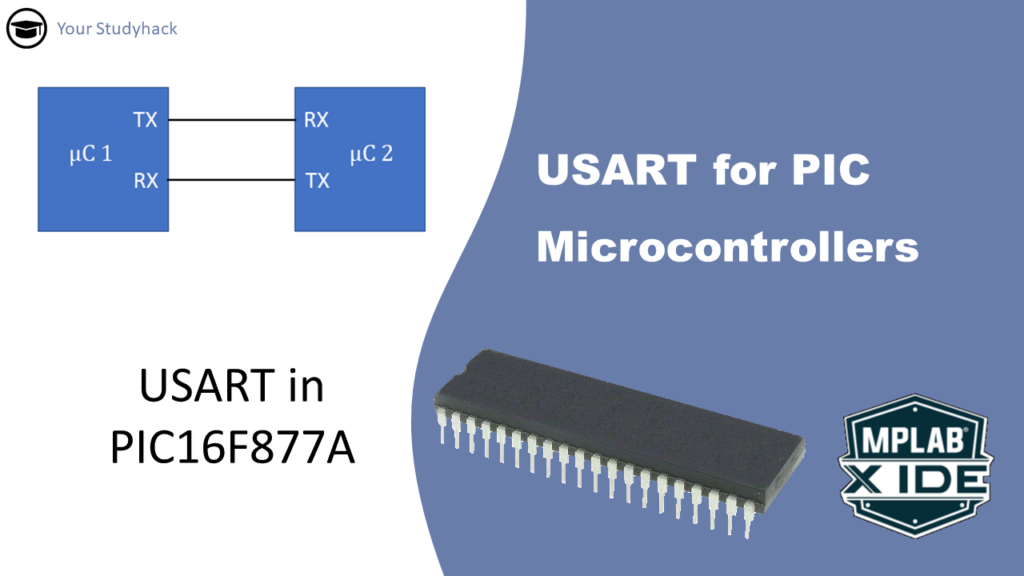
Diagram showing USART communication between two microcontrollers labeled µC1 and µC2, with TX of µC1 connected to RX of µC2 and vice versa. Includes MPLAB X IDE logo and microcontroller image.
USART for PIC Microcontrollers
The USART module, also referred to as the Serial Communications Interface (SCI), is a crucial hardware module that enables a microcontroller to communicate with other...
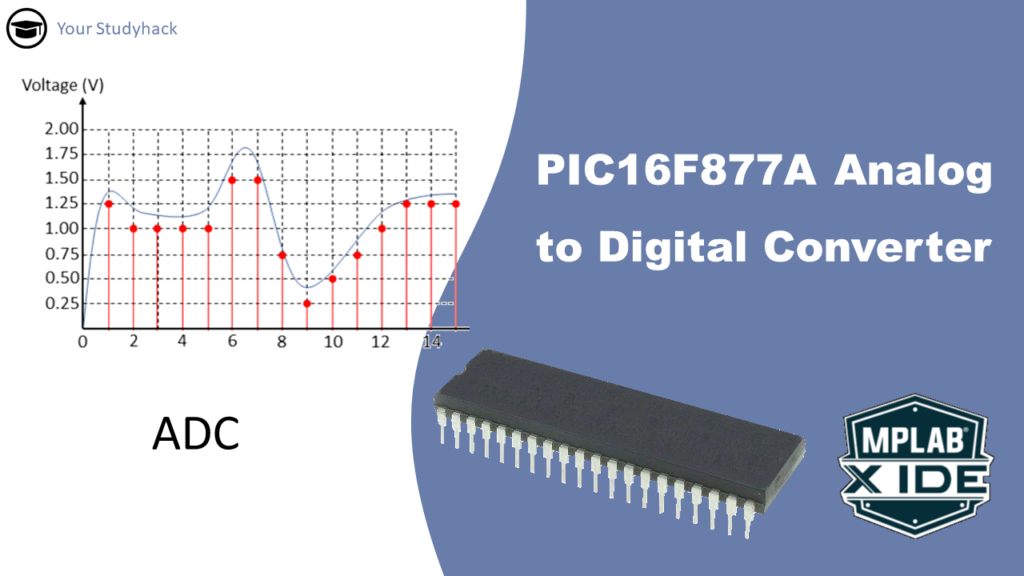
Educational graphic showing the analog-to-digital conversion (ADC) process using the PIC16F877A microcontroller. On the left is a graph of a smooth analog voltage waveform sampled at discrete points (shown as red dots), and on the right is the PIC16F877A chip with MPLAB X IDE branding. The image illustrates how analog voltages are digitized for processing in microcontroller-based systems.
PIC16F877A Analog to Digital Converter (ADC)
The ADC module in microcontrollers indeed allows them to interface with the analog world by converting continuous analog signals into discrete digital values. This capability...
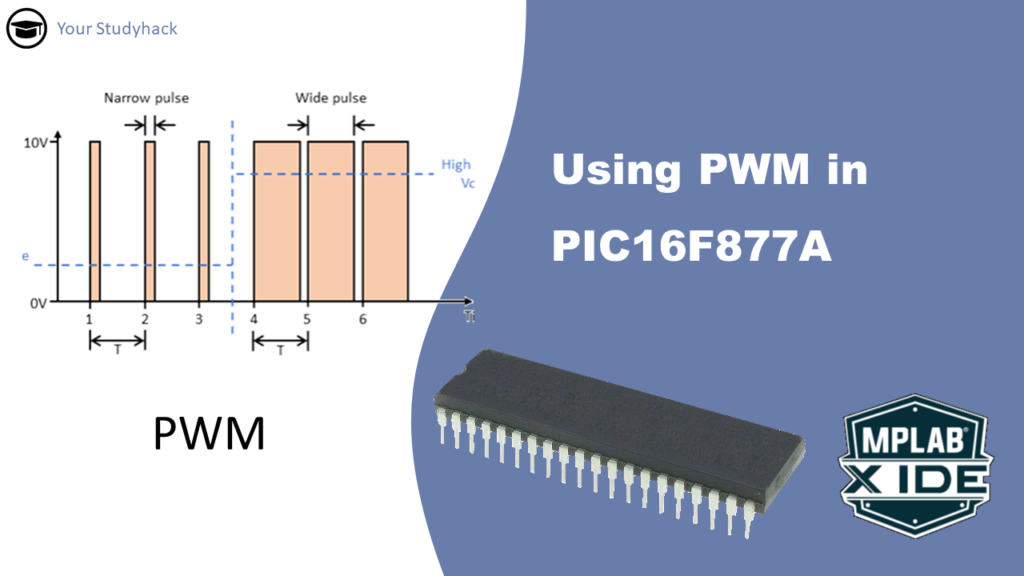
Graphical illustration of PWM signal showing narrow and wide pulses with varying duty cycles. Includes a 10V signal graph, labels for voltage levels, and mentions PIC16F877A microcontroller and MPLAB X IDE.
Using PWM in PIC16F877A
Digital signals (0 or 1) and analog signals (range of values) are both used in electronics. Analog inputs can be converted to digital through an...
Educational slide introducing Timer2 of the PIC16F877A microcontroller. It includes a stopwatch icon with the phrase “Alarm, Timers, how does it work?” on the left, and an image of the PIC microcontroller with MPLAB X IDE branding on the right. The tutorial focuses on Timer2's use in generating precise delays and pulse-width modulation (PWM).
PIC16F877A Timer2 tutorial
The Timer2 module is an 8-bit timer/counter within most PIC MCU devices. Timer2 can increment up to a value of 255 before it overflows back...
Educational slide introducing the Timer1 module of the PIC16F877A microcontroller. The left side shows a stopwatch icon and the question “Alarm, Timers, how does it work?”, while the right side features the microcontroller image and MPLAB X IDE logo. The tutorial focuses on Timer1's role in timing, delays, and interrupts.
PIC16F877A Timer1 Tutorial
The Timer1 module is a 16-bit timer/counter within most PIC MCU devices. Timer1 can increment up to a value of 65535 before it overflows back...